
Smart Marks to CGPA Calculator for Students
| CGPA | Marks (≈) | Grade | Category |
|---|---|---|---|
| 9.0 – 10.0 | 90 – 100 | O | Excellent |
| 8.0 – 8.9 | 80 – 89 | A+ | Very Good |
| 7.0 – 7.9 | 70 – 79 | A | Good |
| 6.0 – 6.9 | 60 – 69 | B+ | Above Average |
| 5.0 – 5.9 | 50 – 59 | B | Average |
| < 5.0 | < 50 | F | Needs Improvement |
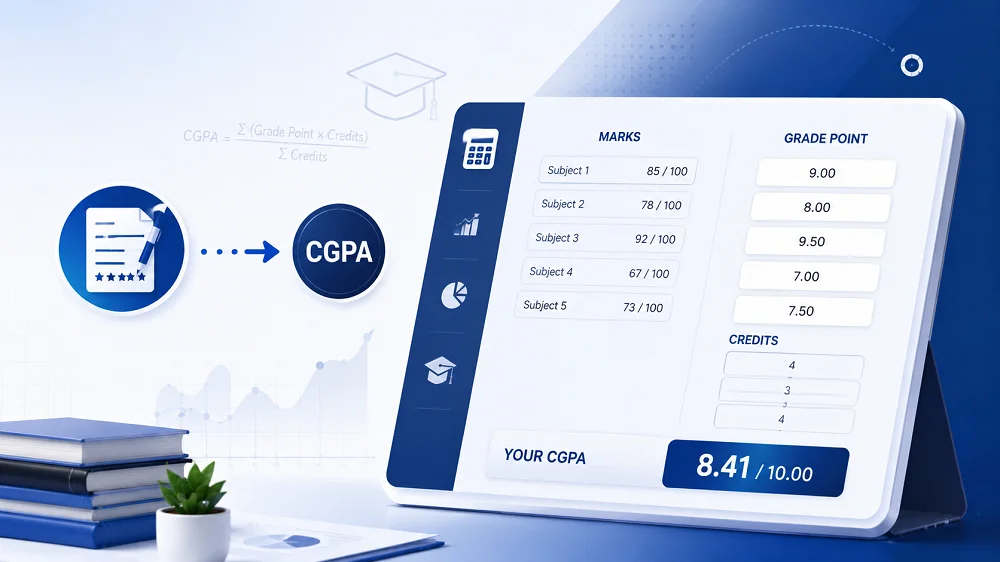
Convert your exam marks into CGPA quickly and accurately using our free Marks to CGPA Calculator. This online tool helps students calculate CGPA from marks, percentages, or grade points without manual calculations. Whether you are preparing for university admissions, scholarships, or semester evaluations, this calculator makes the process simple and fast.
Our Marks to CGPA Calculator is designed for students who want instant academic conversions without confusion. Instead of manually applying formulas, you can calculate your CGPA online in seconds.
Why Use This Calculator?
This tool is especially useful for students using 4-point GPA systems or 10-point CGPA grading scales.
Using the calculator is simple and only takes a few steps.
Step 1 Enter Your Obtained Marks
Type the marks you scored in your exams or subjects.
Step 2 Enter Total Marks
Enter the total marks for the course or semester.
Step 3 Select Your Grading Scale
Choose the grading system used by your school or university, such as:
Step 4 Click the Calculate Button
The calculator processes your data instantly.
Step 5 View Your CGPA Result
Your calculated CGPA appears immediately along with percentage equivalents if available.
Different universities use different methods to calculate CGPA. Some institutions convert percentage into CGPA directly, while others use credit hours and grade points.
Percentage to CGPA Formula
CGPA=Percentage9.5CGPA = \frac{Percentage}{9.5}CGPA=9.5Percentage
This formula is commonly used in some educational boards and universities.
Example:
If your percentage is 85%:
CGPA = 85 ÷ 9.5 = 8.94
Credit Hour Based CGPA Formula
CGPA=Total Grade PointsTotal Credit HoursCGPA = \frac{Total\ Grade\ Points}{Total\ Credit\ Hours}CGPA=Total Credit HoursTotal Grade Points
This method is used by many universities worldwide.
How It Works
This provides a more accurate representation of academic performance.
University-Specific CGPA Methods
Universities may use:
Always check your institution’s official grading policy before finalizing calculations.
Example 1 Percentage to CGPA
Marks Obtained | Total Marks | Percentage | CGPA |
850 | 1000 | 85% | 8.94 |
Example 2 Credit Hour Calculation
Subject | Grade Point | Credit Hours |
Math | 3.7 | 3 |
Physics | 3.5 | 4 |
English | 3.9 | 2 |
Total Grade Points = 28.1
Total Credit Hours = 9
Final CGPA = 3.12
Example 3 Semester-Wise CGPA
Semester | GPA |
Semester 1 | 3.4 |
Semester 2 | 3.7 |
Semester 3 | 3.8 |
Average CGPA = 3.63
Percentage | Approximate CGPA |
95% | 10.0 |
90% | 9.5 |
85% | 8.9 |
80% | 8.4 |
75% | 7.9 |
70% | 7.4 |
65% | 6.8 |
60% | 6.3 |
55% | 5.8 |
50% | 5.3 |
Note: Conversion values may vary depending on university grading systems.
Students often confuse these academic terms. Understanding them correctly helps avoid calculation mistakes.
Marks
Marks are the raw scores obtained in exams or assignments.
Percentage
Percentage represents marks converted into a value out of 100.
GPA
GPA (Grade Point Average) usually measures performance for a single semester.
CGPA
CGPA (Cumulative Grade Point Average) represents overall academic performance across multiple semesters.
GPA vs CGPA
GPA | CGPA |
Semester-based | Overall cumulative score |
Short-term performance | Long-term performance |
Calculated for one term | Calculated for all semesters |
Universities use different grading systems based on their academic policies.
HEC Pakistan CGPA System
Most Pakistani universities follow:
Common in:
CBSE Grading System
Many Indian institutions use:
Engineering University Systems
Engineering universities often:
International GPA Systems
Countries like the USA commonly use:
Feature | 4.0 GPA Scale | 10-Point CGPA Scale |
Common Regions | USA, Pakistan | India |
Maximum Score | 4.0 | 10 |
Grading Method | Letter grades | Percentage-based |
Common Usage | Universities | Schools & colleges |
Understanding your grading scale is important for accurate CGPA conversion.
Many students make simple calculation errors.
Common Mistakes Include:
Using an online Marks to CGPA Calculator helps reduce these mistakes significantly.
An online calculator makes academic conversions much easier.
Key Benefits
Students can quickly estimate their cumulative grade point average without complex calculations.
Understanding grading systems helps students track their academic performance more accurately.
Letter Grades
Grade | Grade Point |
A | 4.0 |
B | 3.0 |
C | 2.0 |
D | 1.0 |
Credit Hours
Credit hours represent the academic weight of each subject.
Subjects with higher credit hours affect CGPA more strongly.
Weighted Average System
Most universities calculate CGPA using weighted averages based on:
You may also find these tools useful:
These related tools help students manage their academic performance more effectively.
Educational Disclaimer:
This calculator provides estimated CGPA values based on commonly used grading systems. Actual university calculations may vary depending on institutional policies, grading methods, and credit-hour structures.
You can convert marks into CGPA using percentage conversion formulas or weighted credit-hour formulas depending on your university system.
A CGPA above 3.5 on a 4.0 scale or above 8 on a 10-point scale is generally considered good.
Yes. GPA measures semester performance, while CGPA measures cumulative academic performance.
Yes. Many institutions use percentage-to-CGPA conversion formulas.
The calculator provides estimated results based on common grading systems. Actual university calculations may vary.