
Track Your Academic Performance with SRM GPA Calculator
The SRM GPA Calculator helps students calculate their semester Grade Point Average quickly and accurately. Instead of manually applying formulas and working through credit calculations, you can enter your grades and credits to get your GPA instantly.
GPA is one of the most important academic indicators at SRM University. Whether you are tracking semester performance, preparing for placements, applying for internships, or planning higher studies, knowing your GPA helps you understand where you stand academically and what improvements may be needed.
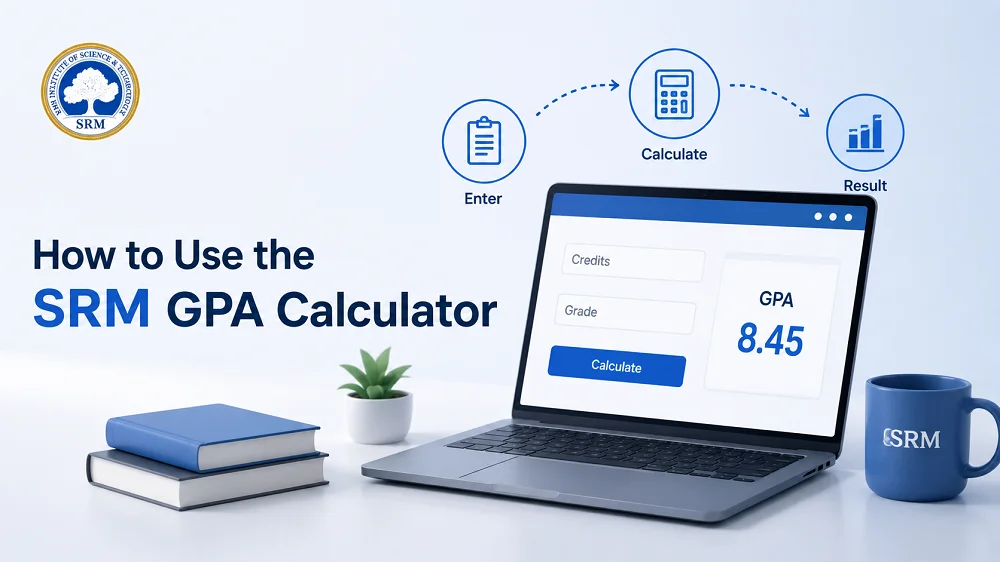
Using the calculator is simple and takes only a few minutes.
Add all subjects you completed during the semester. Include both theory and lab courses if they contribute to GPA calculation.
Choose the grade received in each subject. The calculator automatically converts grades into the corresponding grade points.
Input the credit value assigned to each course. Credits vary depending on the subject and play an important role in GPA calculation.
Click the calculate button after entering all grades and credits. The calculator processes the information instantly.
Your semester GPA will appear immediately. You can use the result to evaluate academic performance and plan future semesters.
GPA stands for Grade Point Average. It is a numerical representation of your academic performance during a single semester.
Every subject carries a certain number of credits and a grade point based on the grade earned. GPA combines these values into a single score that reflects overall semester performance.
A higher GPA generally indicates stronger academic achievement. Many placement opportunities, scholarships, and academic programs consider GPA as part of their eligibility requirements.
SRM uses a credit-based grading system. Each grade corresponds to a numerical grade point, and each subject contributes according to its credit value.
SRM GPA Formula
GPA=∑(Credits×Grade Points)∑CreditsGPA=\frac{\sum(Credits\times Grade\ Points)}{\sum Credits}GPA=∑Credits∑(Credits×Grade Points)
Understanding Grade Points
Every grade earned in a course has a corresponding numerical value.
For example:
These values are used during GPA calculation.
Understanding Course Credits
Credits represent the academic weight of a course.
A core engineering subject may carry 4 credits, while a laboratory course may carry 1 or 2 credits.
Courses with higher credits have a greater impact on your GPA.
How Credit Weightage Affects GPA
Consider two subjects:
Improving your grade in Mathematics will influence your GPA more than improving your grade in the laboratory because the mathematics course carries more credits.
This is why students should pay special attention to high-credit courses.
The SRM grading system converts letter grades into grade points used for GPA calculations.
SRM Grade to Grade Point Conversion Table
Grade | Grade Point |
O | 10 |
A+ | 9 |
A | 8 |
B+ | 7 |
B | 6 |
C | 5 |
F | 0 |
Understanding the SRM Grading System
The grading system is designed to evaluate student performance consistently across different courses.
Higher grades correspond to higher grade points, which directly improve GPA. Lower grades reduce the weighted average and may affect overall academic standing.
Students should always verify the latest academic regulations issued by SRM University because grading policies may occasionally change.
Understanding a real example makes the calculation process much easier.
Example Student GPA Calculation
Subject | Grade | Grade Point | Credit |
Mathematics | O | 10 | 4 |
Physics | A+ | 9 | 4 |
Chemistry | A | 8 | 3 |
Programming | O | 10 | 4 |
Step 1: Calculate Weighted Grade Points
Mathematics:
10 × 4 = 40
Physics:
9 × 4 = 36
Chemistry:
8 × 3 = 24
Programming:
10 × 4 = 40
Total Weighted Points:
40 + 36 + 24 + 40 = 140
Step 2: Calculate Total Credits
4 + 4 + 3 + 4 = 15
Step 3: Apply the Formula
GPA = 140 ÷ 15
GPA = 9.33
Final GPA Result
The student’s semester GPA is 9.33.
This example demonstrates how both grades and credits influence the final result.
Many students focus only on grades and overlook credits. However, credits are equally important.
High-Credit Courses Have More Impact
A 4-credit subject contributes significantly more to GPA than a 1-credit course.
Improving your performance in high-credit courses can noticeably increase your GPA.
Low-Credit Courses Have Less Impact
Although every subject matters, lower-credit courses contribute less to the overall weighted average.
A lower grade in a 1-credit course may not affect GPA as much as a lower grade in a 4-credit subject.
Why Students Should Monitor Credit Distribution
Understanding credit distribution helps students prioritize study efforts and allocate time more effectively throughout the semester.
Students often use these terms interchangeably, but they represent different academic measures.
GPA
GPA refers to the Grade Point Average calculated for a semester.
SGPA
SGPA stands for Semester Grade Point Average. In many institutions, GPA and SGPA are used interchangeably when discussing semester performance.
CGPA
CGPA stands for Cumulative Grade Point Average. It represents academic performance across all completed semesters. Students who want to convert their semester GPA into cumulative performance can use our GPA to CGPA Calculator.
Comparison Table
Metric | Meaning | Scope |
GPA | Grade Point Average | One Semester |
SGPA | Semester Grade Point Average | One Semester |
CGPA | Cumulative Grade Point Average | All Semesters |
Which Metric Matters Most?
Each serves a different purpose.
For placements and higher studies, CGPA is often the most important metric.
GPA is more than just a number on your academic record.
Campus Placements
Many recruiters use GPA or CGPA cutoffs during the hiring process.
Maintaining a strong academic record can increase access to placement opportunities.
Internship Applications
Internship programs often consider academic performance when shortlisting candidates.
A good GPA may strengthen your application.
Scholarship Eligibility
Certain scholarships require students to maintain minimum GPA standards.
Regular GPA monitoring helps ensure continued eligibility.
Higher Education Applications
Universities offering postgraduate programs frequently evaluate academic performance through GPA or CGPA. Students can also check their equivalent percentage using our CGPA to Percentage Calculator.
A strong GPA can improve admission prospects.
Even simple mistakes can lead to inaccurate GPA calculations.
Entering Incorrect Credits
Always verify subject credits before calculation.
Incorrect credit values can significantly alter the result.
Selecting the Wrong Grade
Choosing the wrong grade point can affect the weighted average.
Double-check every entry before calculating.
Forgetting a Subject
Leaving out a subject can produce an inaccurate GPA.
Include all completed courses that contribute to semester evaluation.
Ignoring Failed Subjects
Depending on academic regulations, failed subjects may affect GPA calculations.
Always verify university guidelines.
Manual Calculation Errors
Manual calculations often lead to mistakes.
Using an SRM GPA Calculator reduces the risk of errors and saves time.
Improving GPA requires consistent effort and smart planning.
Focus on High-Credit Subjects
Performing well in high-credit courses has the greatest impact on GPA.
Prioritize these courses throughout the semester.
Improve Internal Assessment Scores
Assignments, quizzes, and internal assessments contribute to final grades.
Strong internal performance can help secure higher grade points.
Stay Consistent Throughout the Semester
Avoid relying solely on end-semester exams.
Regular preparation usually produces better academic outcomes.
Track Your GPA Regularly
Calculating GPA after each semester helps identify trends and areas for improvement.
Set Realistic GPA Goals
Establish achievable targets and monitor progress semester by semester.
Small improvements can lead to substantial long-term gains.
Fast Results
Get your GPA within seconds without performing manual calculations.
Accurate Calculations
The calculator follows the standard credit-weighted GPA formula.
Easy to Use
The interface is simple and beginner-friendly.
Mobile Friendly
Calculate GPA from any device, including smartphones and tablets.
Free Online Access
Use the tool anytime without registration or installation.
GPA is calculated by multiplying grade points by subject credits, adding all weighted points, and dividing the result by total credits completed during the semester.
The standard formula is the weighted average of grade points and credits. It accounts for both academic grades and course credit values.
Yes. GPA represents performance for one semester, while CGPA represents cumulative performance across all completed semesters.
Yes. You can calculate GPA for any semester by entering the grades and credits for the courses completed during that semester.
Credits determine how much influence a course has on your final GPA. Higher-credit courses contribute more to the overall weighted average.
The calculator is designed to use the commonly followed SRM grading scale and GPA calculation methodology.
A GPA above 8 is generally considered strong. However, requirements may vary depending on placements, scholarships, and academic goals.
Focus on high-credit courses, perform well in internal assessments, maintain consistent study habits, and track academic performance regularly.