Calculate Your CGPA from Multiple SGPAs in Seconds
Standard formula: Percentage = CGPA × 10
| Semester | SGPA | Credits | SGPA × Credits |
|---|---|---|---|
| Sem 1 | 8.0 | 20 | 160.0 |
| Sem 2 | 9.0 | 22 | 198.0 |
| Sem 3 | 7.5 | 18 | 135.0 |
| Total | — | 60 | 493.0 |
Use our free SGPA to CGPA Calculator to instantly convert your semester GPA into cumulative GPA with accurate results. Whether you are tracking academic performance, preparing for placements, applying for scholarships, or calculating final university scores, this tool helps you calculate CGPA quickly without manual errors.
The calculator is beginner-friendly, mobile-friendly, and designed for students who want fast semester-wise CGPA calculations in seconds.
Enter your semester SGPA values in the calculator above to instantly calculate your overall CGPA.
Features of This Calculator
Using the SGPA to CGPA Calculator is simple and takes only a few seconds.
Add the SGPA you received in each semester. You can enter decimal values such as 7.5, 8.2, or 9.1.
If you have completed multiple semesters, add all semester SGPA values to calculate your cumulative GPA accurately.
Once all semester values are entered, click the calculate button to process the result instantly.
The calculator will instantly display your cumulative CGPA based on the semester values provided.
You can edit semester values anytime and recalculate your CGPA without refreshing the page.
The SGPA to CGPA formula is based on averaging semester grade point averages across all semesters.
Standard SGPA to CGPA Formula
CGPA=SGPA1+SGPA2+SGPA3+…+SGPAnnCGPA = \frac{SGPA_1 + SGPA_2 + SGPA_3 + … + SGPA_n}{n}CGPA=nSGPA1+SGPA2+SGPA3+…+SGPAn
What Does This Formula Mean?
To calculate CGPA:
The result is your cumulative grade point average (CGPA).
This method is commonly used by universities and colleges that follow semester-based grading systems.
Weighted vs Non-Weighted CGPA
Some universities use a simple average method, while others calculate CGPA using credit-weighted systems.
In weighted calculations:
Always check your university grading policy for exact calculation methods.
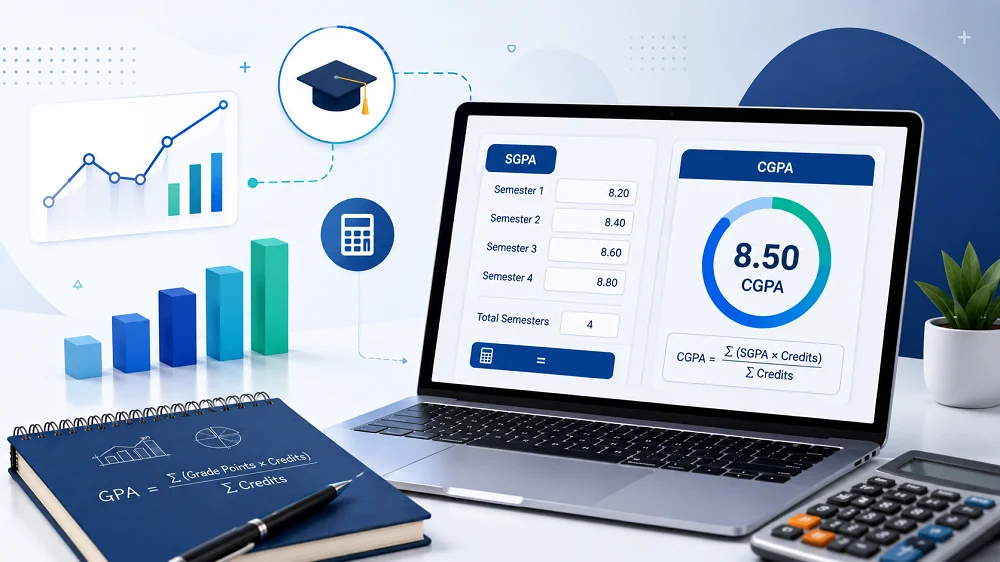
Here is a simple example showing how CGPA is calculated from SGPA values.
Semester | SGPA |
Semester 1 | 8.2 |
Semester 2 | 7.8 |
Semester 3 | 8.5 |
Semester 4 | 8.0 |
Manual CGPA Calculation
CGPA=8.2+7.8+8.5+8.04=8.125CGPA = \frac{8.2 + 7.8 + 8.5 + 8.0}{4} = 8.125CGPA=48.2+7.8+8.5+8.0=8.125
Final Result
The final CGPA is 8.13 after rounding the result to two decimal places.
This score represents the student’s overall academic performance across all semesters.
SGPA stands for Semester Grade Point Average.
It measures a student’s academic performance during a single semester. Universities calculate SGPA based on:
Each subject carries specific credits, and the final SGPA reflects the weighted average of all subjects completed during that semester.
Why SGPA Matters
SGPA helps students:
Many universities display SGPA on semester report cards and transcripts.
CGPA stands for Cumulative Grade Point Average.
Unlike SGPA, CGPA reflects overall academic performance across the entire course or degree program.
It combines semester results to provide a cumulative score.
Why CGPA Is Important
CGPA plays a major role in:
Many employers and universities use CGPA to evaluate academic consistency and student performance.
Feature | SGPA | CGPA |
Full Form | Semester Grade Point Average | Cumulative Grade Point Average |
Duration | One semester | Entire course |
Purpose | Semester evaluation | Overall academic performance |
Calculation | Based on semester subjects | Based on all semesters |
Usage | Short-term performance | Final academic score |
SGPA focuses on one semester, while CGPA measures overall performance throughout the academic program.
Universities use different grading systems to calculate CGPA.
Credit-Based Grading Systems
Most colleges use a credit-based academic structure where:
Grade Point Calculation
Universities assign grade points such as:
These grade points are multiplied by subject credits to calculate semester GPA.
Semester Aggregation Method
After calculating semester SGPA values, universities combine them to determine cumulative CGPA.
Some institutions:
Always refer to your university guidelines for exact methods.
In many universities, CGPA is not calculated using a simple average.
Instead, universities use weighted calculations based on credits.
Why Credits Matter
Subjects with higher credits contribute more to the final CGPA.
For example:
Weighted CGPA Formula
In weighted systems:
This method provides a more accurate representation of academic performance.
Many students also need to convert CGPA into percentage for applications and eligibility requirements.
Common CGPA to Percentage Formula
Percentage=CGPA×9.5Percentage = CGPA \times 9.5Percentage=CGPA×9.5
Important Note About Percentage Conversion
Different universities use different conversion formulas.
Some institutions:
Always verify your university’s official conversion method before submitting academic documents.
An online calculator makes GPA conversion faster, simpler, and more accurate.
Saves Time
No need for lengthy manual calculations.
Reduces Calculation Errors
Automatic processing reduces human mistakes.
Instant Results
Get accurate CGPA results immediately.
Easy Semester Tracking
Add multiple semester values in one place.
Mobile-Friendly Usage
Use the calculator from phones, tablets, or desktops.
Beginner-Friendly Interface
Simple design makes the tool accessible for all students.
Students often make mistakes while manually converting SGPA into CGPA.
Entering Incorrect SGPA Values
Even a small input error can affect the final result.
Ignoring Credit Hours
Some universities use weighted GPA systems based on credits.
Using Wrong Semester Count
Incorrect semester totals lead to inaccurate averages.
Confusing SGPA with Percentage
SGPA and percentages are different scoring systems.
Rounding Errors
Manual calculations often produce rounding mistakes.
Using an online SGPA to CGPA Calculator helps avoid these problems.
A good CGPA depends on university standards, career goals, and competition levels.
CGPA Range | Performance |
9.0+ | Excellent |
8.0 – 8.9 | Very Good |
7.0 – 7.9 | Good |
6.0 – 6.9 | Average |
Why a Good CGPA Matters
A strong CGPA can improve:
However, skills, projects, and practical experience are also important for career growth.
Many students confuse SGPA, CGPA, and GPA because all are grading metrics.
SGPA
Measures semester performance.
CGPA
Measures overall academic performance across all semesters.
GPA
Often used internationally to represent grade point averages in colleges and universities.
Different countries and universities may use different grading scales and GPA systems.
You may also find these related academic tools useful:
These tools help students simplify academic calculations and grading conversions.
Conclusion
Our SGPA to CGPA Calculator helps students calculate cumulative GPA quickly, accurately, and without manual errors. Whether you want to track semester performance, prepare for placements, or convert academic scores, this tool provides an easy and reliable solution.
Use the calculator above to instantly convert SGPA into CGPA and explore related GPA and percentage calculators for additional academic conversions.
No. SGPA measures performance for one semester, while CGPA represents overall academic performance across all semesters.
CGPA is usually calculated by averaging all semester SGPA values. Some universities also use weighted credit-based systems.
Yes. Many universities allow percentage conversion using CGPA formulas or official conversion multipliers.
No. Different universities may use different grading systems, weightage methods, and conversion formulas.
Yes. The calculator provides accurate results based on standard SGPA averaging formulas commonly used by universities.
A CGPA above 8 is generally considered very good in most universities.
Yes. You can enter SGPA values for all semesters to calculate your cumulative GPA instantly.
GPA may represent a single term or general grading average, while CGPA usually represents cumulative academic performance across an entire program.