Many SRM students need to calculate their CGPA when applying for internships, placements, scholarships, higher studies, or simply tracking their academic performance. Understanding how CGPA works helps you set academic goals, monitor progress, and make better decisions throughout your degree program.
Learning how to calculate CGPA in SRM is not complicated once you understand the grading system and credit structure. Whether you want to calculate your score manually or verify the result from an online calculator, knowing the process can help you avoid mistakes and understand how each subject affects your overall performance.
This guide explains the SRM grading system, official CGPA formula, step-by-step calculation process, worked examples, CGPA-to-percentage conversion, and practical tips for improving your academic performance.
How to Calculate CGPA in SRM Quickly
To calculate CGPA in SRM University, multiply the grade point earned in each subject by its credit value, add all credit points together, and divide the total by the total credits completed.
Quick Steps:
- Collect grades for all subjects.
- Convert grades into grade points.
- Multiply grade points by course credits.
- Add all credit points.
- Divide the total credit points by total credits.
Students who want instant results can use an SRM CGPA Calculator instead of performing calculations manually.
What Is CGPA in SRM University
CGPA stands for Cumulative Grade Point Average. It represents your overall academic performance across all semesters completed during your degree program.
Unlike semester-based scores, CGPA combines results from multiple semesters to provide a complete picture of your academic record. Universities, recruiters, scholarship providers, and higher education institutions often use CGPA as an indicator of consistent academic performance.
CGPA is important because it can influence:
- Campus placement opportunities
- Internship applications
- Scholarship eligibility
- Higher education admissions
- Academic awards and recognitions
- Competitive examination requirements
Maintaining a strong CGPA can create more opportunities during and after graduation.
Difference Between GPA, SGPA, and CGPA
Students often confuse GPA, SGPA, and CGPA. Although they are related, they measure different aspects of academic performance.
| Metric | Full Form | Purpose |
| GPA | Grade Point Average | Performance in a group of courses |
| SGPA | Semester Grade Point Average | Performance in one semester |
| CGPA | Cumulative Grade Point Average | Overall performance across all semesters |
GPA
GPA measures performance within a specific set of courses. Some institutions use GPA for individual semesters.
SGPA
SGPA reflects performance during a single semester. It is calculated using the grades and credits earned during that semester only.
CGPA
CGPA combines results from all semesters completed so far. It provides a cumulative academic score and is usually the most important metric for placements and higher studies.
SRM Grading System Explained
Before calculating CGPA, students must understand how grades are converted into grade points.
| Grade | Grade Point |
| O | 10 |
| A+ | 9 |
| A | 8 |
| B+ | 7 |
| B | 6 |
| C | 5 |
| D | 4 |
| F | 0 |
O Grade
O stands for Outstanding and carries the highest grade point of 10.
A+ Grade
A+ corresponds to 9 grade points and indicates excellent performance.
A Grade
A corresponds to 8 grade points and represents very good performance.
B+ Grade
B+ corresponds to 7 grade points and reflects good understanding of the subject.
B Grade
B carries 6 grade points and indicates satisfactory performance.
C Grade
C carries 5 grade points and generally represents average performance.
D Grade
D corresponds to 4 grade points and is usually considered the minimum passing grade.
F Grade
F indicates failure and carries 0 grade points. Failed subjects can negatively impact SGPA and CGPA until they are cleared according to university regulations.
Official Formula Used to Calculate CGPA in SRM
SRM follows a credit-based grading system. This means subjects with more credits contribute more heavily to your CGPA.
The formula is:
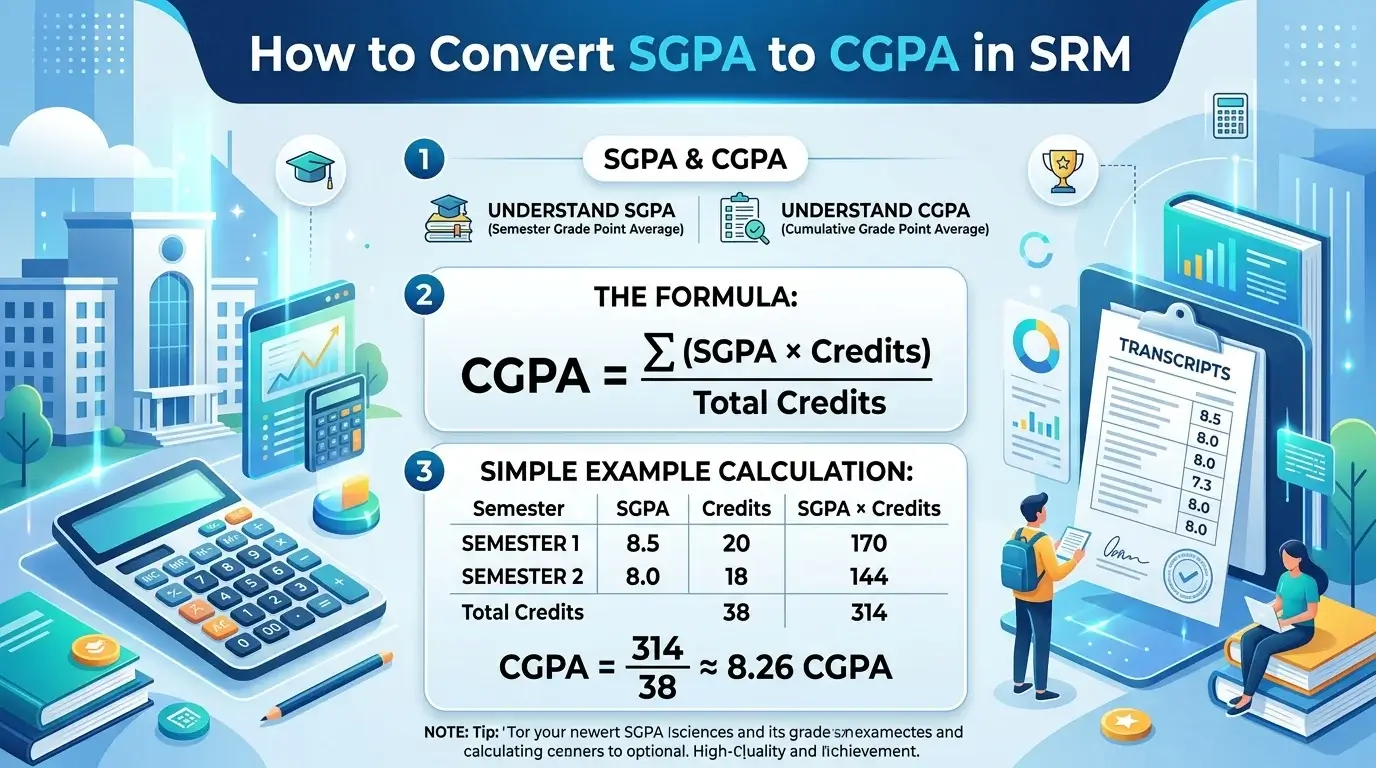
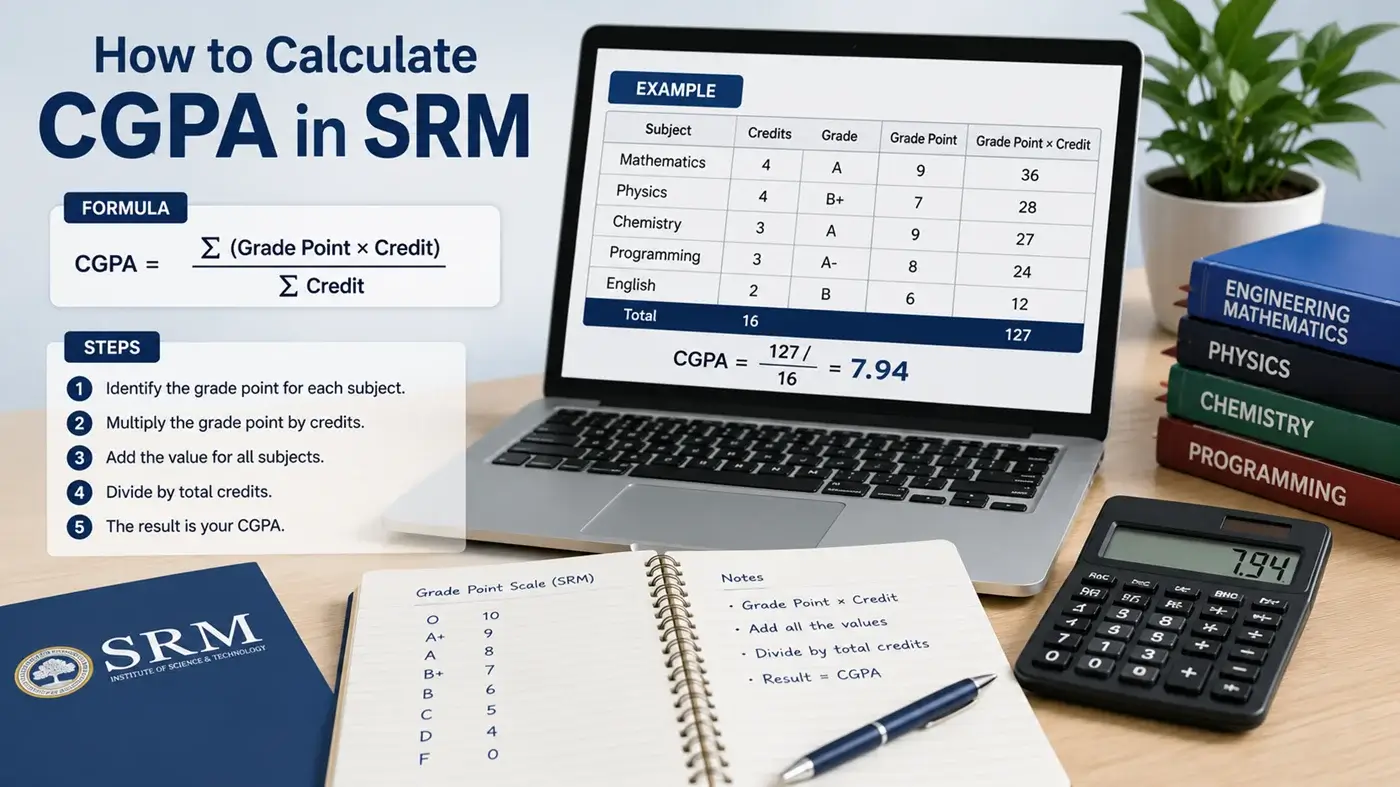
CGPA = Total Credit Points ÷ Total Credits
What Are Credit Points
Credit points are calculated by multiplying the grade point earned in a subject by the subject’s credit value.
Example:
- Credits = 4
- Grade = A+
- Grade Point = 9
Credit Points = 4 × 9 = 36
What Are Total Credits
Total credits are the sum of all credits earned across completed subjects.
Example:
- Mathematics = 4 credits
- Physics = 3 credits
- Programming = 4 credits
- English = 2 credits
Total Credits = 13
Why Credits Matter
Not all subjects contribute equally. A four-credit subject has a much larger effect on CGPA than a one-credit subject.
Students aiming to improve their CGPA should focus particularly on high-credit courses.
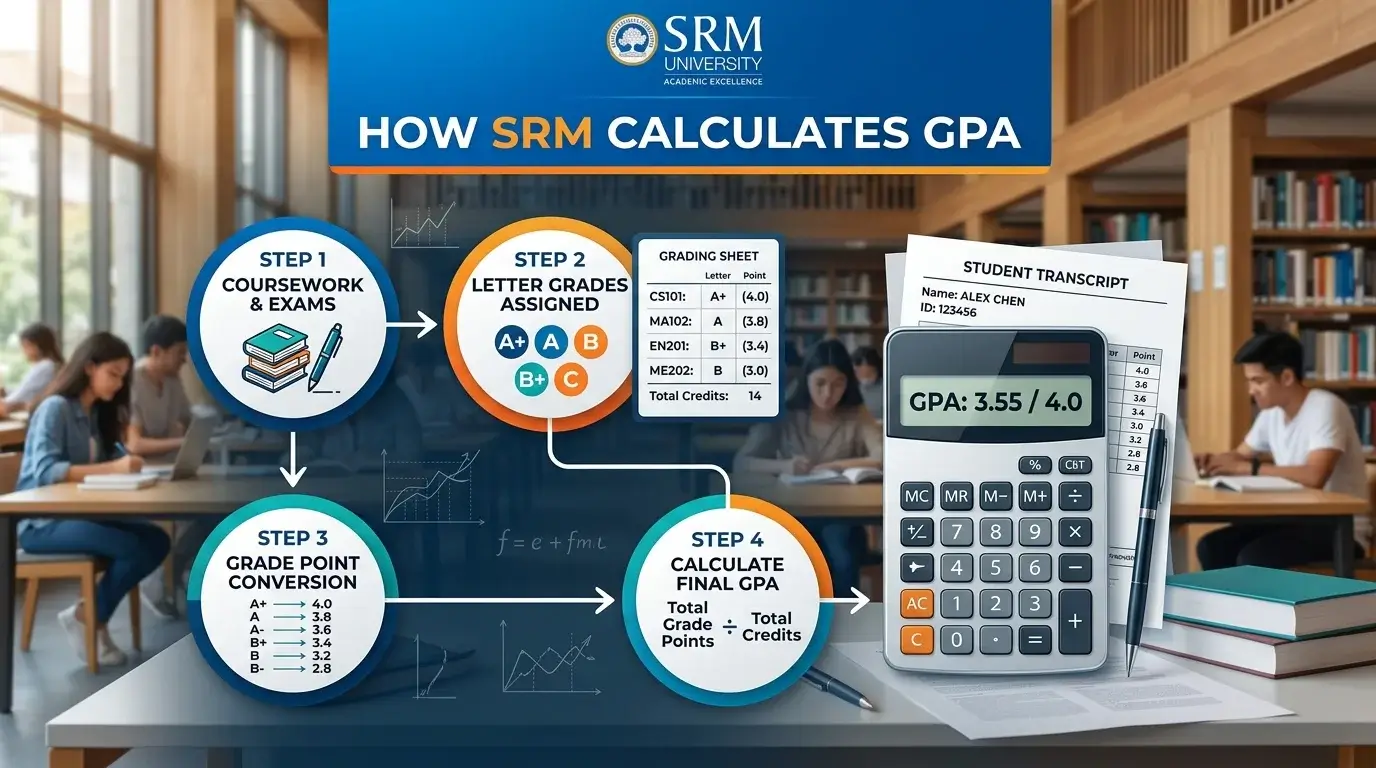
Step-by-Step Guide to Calculate CGPA in SRM
Step One – Collect Your Grades
Gather your semester grade cards or academic transcript and list all completed subjects.
Step Two – Convert Grades Into Grade Points
Use the SRM grading table to convert letter grades into numerical grade points.
Step Three – Multiply Credits by Grade Points
Calculate credit points for every subject.
Example:
| Subject | Credits | Grade | Grade Point | Credit Points |
| Mathematics | 4 | O | 10 | 40 |
| Physics | 3 | A+ | 9 | 27 |
| Programming | 4 | A | 8 | 32 |
Step Four – Add Total Credit Points
40 + 27 + 32 = 99
Total Credit Points = 99
Step Five – Add Total Credits
4 + 3 + 4 = 11
Total Credits = 11
Step Six – Calculate CGPA
CGPA = 99 ÷ 11
CGPA = 9.00
SRM CGPA Calculation Example
The following example demonstrates the complete calculation process.
| Subject | Credits | Grade | Grade Point | Credit Points |
| Engineering Mathematics | 4 | O | 10 | 40 |
| Physics | 3 | A+ | 9 | 27 |
| Chemistry | 3 | A | 8 | 24 |
| Programming Fundamentals | 4 | O | 10 | 40 |
| English Communication | 2 | A+ | 9 | 18 |
Total Credit Points
40 + 27 + 24 + 40 + 18 = 149
Total Credits
4 + 3 + 3 + 4 + 2 = 16
Final CGPA
149 ÷ 16 = 9.31
The student’s CGPA is 9.31.
Semester-Wise CGPA Example
Many students calculate CGPA using multiple semester results.
| Semester | SGPA | Credits |
| Semester 1 | 8.50 | 24 |
| Semester 2 | 8.80 | 25 |
| Semester 3 | 9.10 | 26 |
Weighted Grade Points
Semester 1:
8.50 × 24 = 204
Semester 2:
8.80 × 25 = 220
Semester 3:
9.10 × 26 = 236.6
Total Grade Points
204 + 220 + 236.6 = 660.6
Total Credits
24 + 25 + 26 = 75
Final CGPA
660.6 ÷ 75 = 8.81
This cumulative approach ensures that every semester contributes proportionally to the final CGPA.
How Credits Affect Your CGPA
Credits determine the weight of each subject in your CGPA calculation.
High-Credit Subjects
Examples include:
- Engineering Mathematics
- Core Technical Courses
- Major Projects
Strong performance in these subjects can significantly improve CGPA.
Low-Credit Subjects
Examples include:
- Laboratory Courses
- Workshops
- Skill Development Courses
Although important, they usually have a smaller effect on the final score.
Academic Strategy
Students aiming for a higher CGPA should focus on performing well in high-credit subjects because they contribute more heavily to the final calculation.
How Backlogs and Arrears Affect CGPA in SRM
Backlogs can impact both academic progress and overall performance indicators.
Impact of F Grades
An F grade carries zero grade points.
Example:
4-credit course × 0 grade points = 0 credit points
This can reduce SGPA and CGPA considerably.
Clearing an Arrear
When students successfully clear an arrear subject, the updated result may improve overall academic performance according to university regulations.
Common Misconceptions
Many students mistakenly believe:
- One backlog has no impact.
- Credits do not matter.
- CGPA automatically improves without recalculation.
Understanding the credit system helps avoid these misunderstandings.
How to Convert CGPA to Percentage in SRM
Students often need percentage values for applications and examinations.
A commonly used conversion method is:
Percentage = CGPA × 10
Students should always verify the latest university guidelines before using any conversion formula for official purposes.
Examples
| CGPA | Percentage |
| 6.5 | 65% |
| 7.0 | 70% |
| 7.5 | 75% |
| 8.0 | 80% |
| 8.5 | 85% |
| 9.0 | 90% |
When Percentage Conversion Is Needed
Percentage values may be required for:
- Placement applications
- Government examinations
- Scholarship forms
- Higher education admissions
- International university applications
What Is a Good CGPA in SRM
The definition of a good CGPA depends on your goals.
| CGPA | Performance Level |
| 9.0+ | Excellent |
| 8.0–8.9 | Very Good |
| 7.0–7.9 | Good |
| 6.0–6.9 | Average |
| Below 6.0 | Needs Improvement |
For Placements
Many recruiters use CGPA as an initial screening criterion. Maintaining a CGPA above 7 generally increases eligibility for opportunities.
For Higher Studies
A CGPA above 8 can strengthen applications to competitive postgraduate programs.
For Scholarships
Many scholarship programs use minimum CGPA requirements for eligibility and renewal.
Common Mistakes Students Make When Calculating CGPA
Ignoring Credits
Every subject has a different weight. Ignoring credits leads to incorrect calculations.
Using Incorrect Grade Points
Always use the official grading scale when converting grades.
Confusing SGPA and CGPA
SGPA measures one semester, while CGPA measures overall academic performance.
Calculation Errors
Manual calculations can lead to:
- Addition mistakes
- Multiplication errors
- Missing subjects
Using a calculator helps eliminate these problems.
Why Use Our SRM CGPA Calculator
Manual calculations are useful for understanding the process, but calculators offer convenience and accuracy.
Benefits include:
- Instant results
- Faster calculations
- Reduced calculation errors
- Mobile-friendly access
- Multiple semester support
- Better academic planning
Students can calculate CGPA anytime without manually applying formulas.
Related SRM Academic Calculators
SRM SGPA Calculator
Calculate your semester performance using subject grades and credits.
SGPA to CGPA Calculator
Combine semester results to calculate cumulative performance.
CGPA to Percentage Calculator
Convert CGPA into percentage values quickly.
GPA Calculator
Calculate grade point averages for specific semesters or courses.
Marks to CGPA Calculator
Estimate CGPA using marks obtained in examinations.
These calculators help students manage different academic calculations efficiently.
Tips to Improve Your CGPA in SRM
Focus on High-Credit Subjects
Improving grades in high-credit courses can produce noticeable improvements in CGPA.
Avoid Backlogs
Clearing subjects on the first attempt prevents unnecessary academic pressure.
Monitor Your Performance Regularly
Tracking SGPA and CGPA each semester helps identify areas needing improvement.
Set Academic Targets
Establish realistic semester goals and review progress consistently.
Use Academic Tools
CGPA and SGPA calculators can help students plan future performance requirements.
Final Thoughts
Understanding how to calculate CGPA in SRM helps students monitor academic performance, plan future goals, and make informed decisions throughout their degree. Once you understand grade points, credits, and the calculation formula, interpreting your academic progress becomes much easier.
Whether you choose to calculate CGPA manually or use an SRM CGPA Calculator, the key is understanding how each subject contributes to your overall score. Regularly tracking your CGPA can help you stay focused on placements, scholarships, internships, and higher education opportunities.