Quick Answer: To convert SGPA to CGPA in SRM, use the credit-weighted average of all your semester SGPAs. Multiply each semester’s SGPA by its semester credits, add the results, and divide by the total semester credits. If every semester has the same number of credits, taking the average of all SGPAs gives the same result. For the fastest and most accurate calculation, use our SRM CGPA Calculator.
What Is SGPA in SRM?
SGPA (Semester Grade Point Average) is the average grade point you earn during a single semester. It measures your academic performance by considering both the grade points earned in each subject and the credits assigned to those subjects.
SRM calculates SGPA at the end of every semester so students can understand how they performed during that specific academic term.
Your SGPA helps you:
- Track your semester performance
- Identify subjects that need improvement
- Monitor academic progress throughout your degree
A higher SGPA generally indicates better performance in that semester.
What Is CGPA in SRM?
CGPA (Cumulative Grade Point Average) represents your overall academic performance across all completed semesters.
Unlike SGPA, which measures one semester, CGPA combines every semester’s performance into a single score. Since it covers your entire course, CGPA is one of the most important academic indicators.
Your CGPA is commonly used for:
- Campus placements
- Internship applications
- Scholarships
- Higher education admissions
- Academic awards
Maintaining a good CGPA can improve future academic and career opportunities.
How to Convert SGPA to CGPA in SRM
Many students think they can simply average all their semester SGPAs. While this works in some cases, it is not always accurate.
SRM generally calculates CGPA using a credit-weighted average. This means semesters with more academic credits contribute more to your final CGPA than semesters with fewer credits.
When does a simple average work?
If every semester has exactly the same number of credits, averaging all semester SGPAs produces the same CGPA.
When is a weighted average required?
If semester credits differ—even by a few credits—you should use the weighted formula. This gives a more accurate result because each semester contributes according to its academic workload.
For quick and error-free calculations, you can use our SRM CGPA Calculator, which automatically applies the correct formula.
SGPA to CGPA Formula Explained
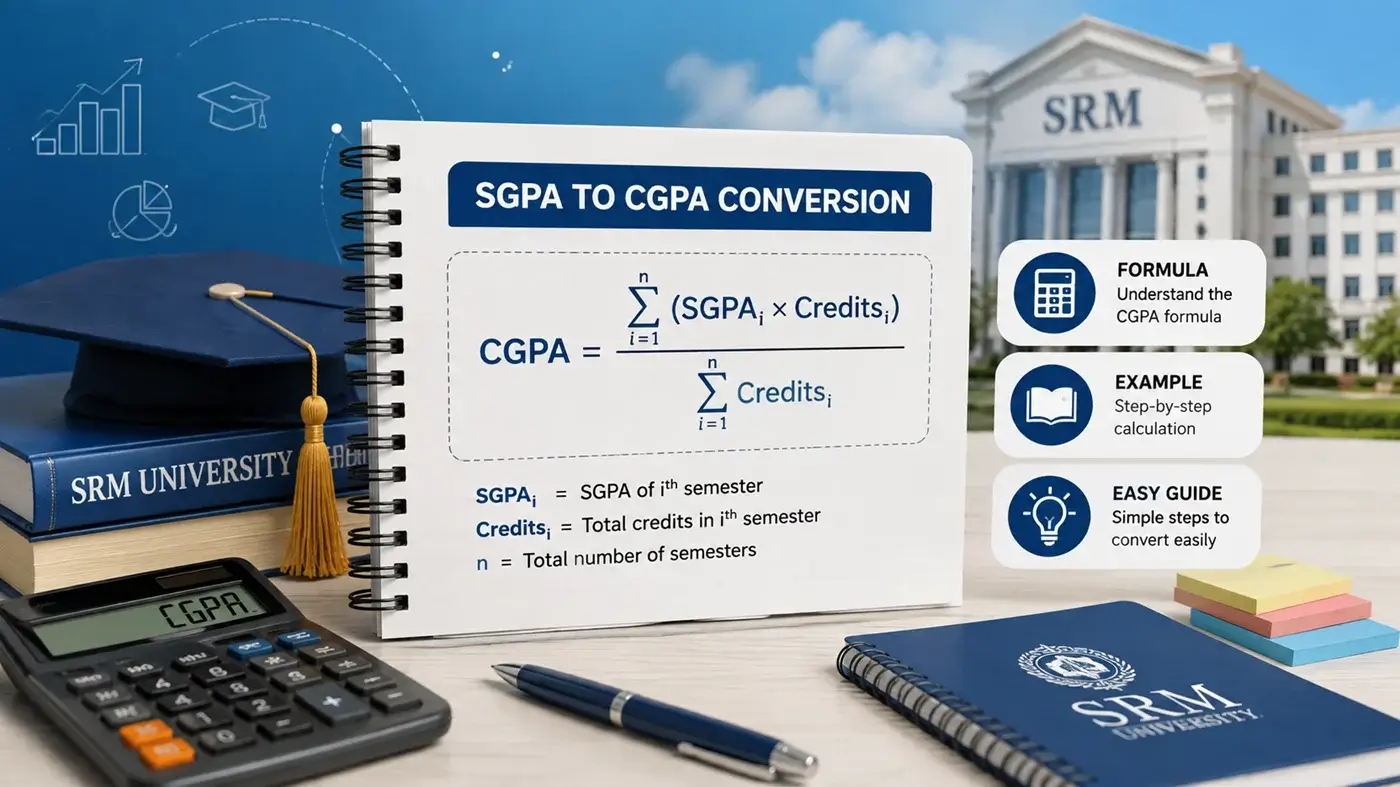
The standard formula is:
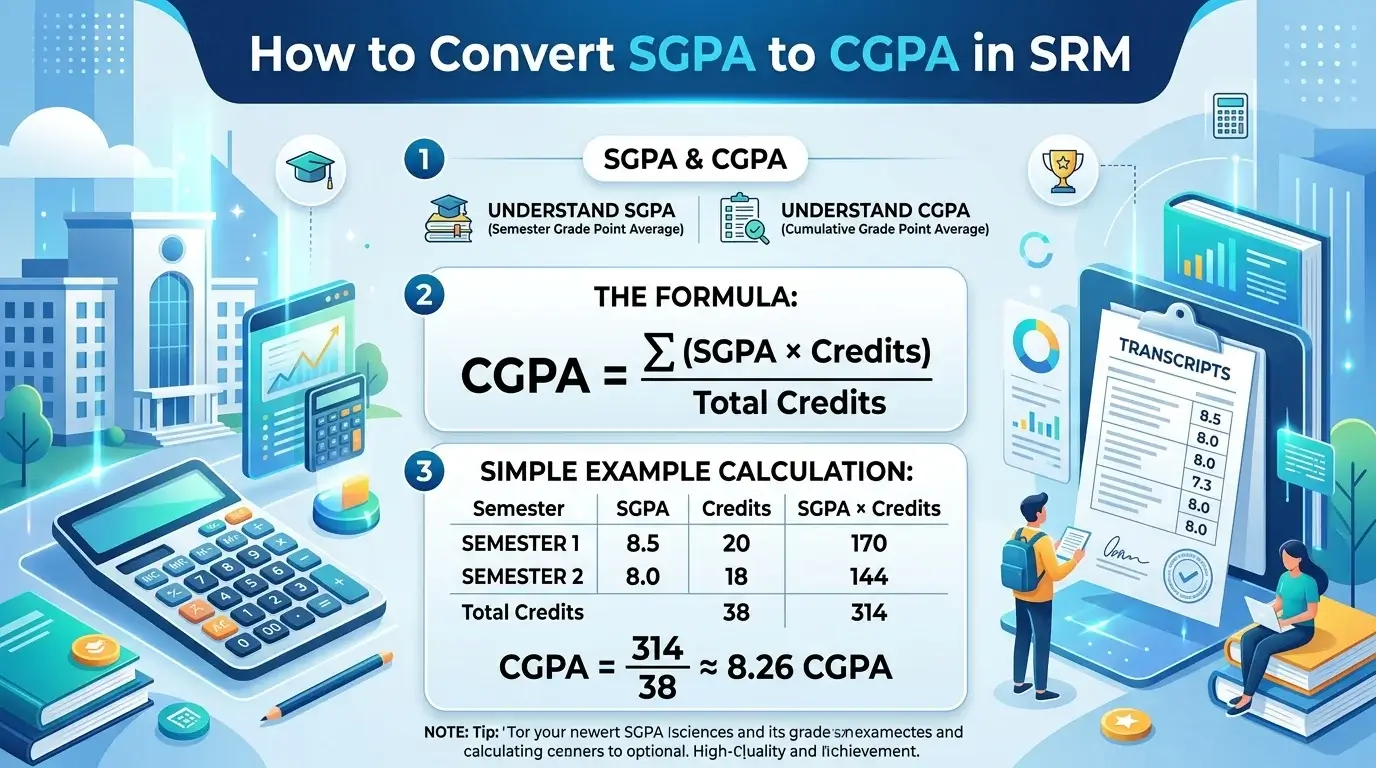
CGPA = Σ (SGPA × Semester Credits) ÷ Total Semester Credits
Let’s understand each part.
| Term | Meaning |
| SGPA | Semester Grade Point Average |
| Semester Credits | Total academic credits completed in that semester |
| Total Credits | Sum of credits from all completed semesters |
| Weighted Average | A method that gives more importance to semesters with more credits |
This formula ensures your CGPA accurately reflects the workload completed during each semester.
Step-by-Step SGPA to CGPA Conversion
Follow these steps to calculate your CGPA manually.
Step 1
Collect the SGPA for every completed semester.
Step 2
Write down the total semester credits for each semester.
Step 3
Multiply each SGPA by its corresponding semester credits.
Step 4
Add all the weighted values together.
Step 5
Add the total semester credits.
Step 6
Divide the total weighted value by the total semester credits.
Tip: Always verify your SGPA values and semester credits using your official academic transcript or semester result before calculating your CGPA.
Example of SGPA to CGPA Calculation
Suppose a student has the following results.
| Semester | SGPA | Credits |
| Semester 1 | 8.20 | 20 |
| Semester 2 | 8.70 | 24 |
| Semester 3 | 9.10 | 18 |
Weighted Calculation
| Semester | SGPA × Credits |
| Semester 1 | 8.20 × 20 = 164.00 |
| Semester 2 | 8.70 × 24 = 208.80 |
| Semester 3 | 9.10 × 18 = 163.80 |
Total Weighted Points = 536.60
Total Credits = 62
CGPA = 536.60 ÷ 62 = 8.65
Simple Average
(8.20 + 8.70 + 9.10) ÷ 3 = 8.67
Notice that the simple average (8.67) is slightly different from the weighted CGPA (8.65). This happens because Semester 2 has more credits and therefore contributes more to the final CGPA.
The greater the difference in semester credits, the larger the difference between the simple average and the weighted average.
Why Semester Credits Matter
Semester credits represent the academic weight assigned to your courses.
A semester containing more course credits contributes more to your overall CGPA than a semester with fewer credits.
Think of it like carrying bags of different weights.
If one bag weighs 20 kg and another weighs 5 kg, the heavier bag contributes more to the total weight. Similarly, semesters with more credits have a greater impact on your CGPA.
This is why universities use a weighted average instead of treating every semester equally.
SGPA vs CGPA
| SGPA | CGPA |
| Measures one semester | Measures all completed semesters |
| Calculated after every semester | Updated after every semester |
| Shows semester performance | Shows overall academic performance |
| Useful for short-term progress | Used for placements and higher studies |
| Changes every semester | Represents cumulative academic record |
Understanding the difference helps students better interpret their academic results.
Manual Calculation vs SRM CGPA Calculator
| Feature | Manual Calculation | SRM CGPA Calculator |
| Accuracy | Depends on calculations | Highly accurate |
| Speed | Several minutes | Instant |
| Convenience | Requires manual work | Very easy |
| Manual Effort | High | Minimal |
| Risk of Errors | Higher | Lower |
Instead of spending time performing manual calculations, use our SRM CGPA Calculator to convert your SGPA into CGPA instantly.
Common SGPA to CGPA Conversion Mistakes
Avoid these common mistakes when calculating your CGPA.
- Ignoring semester credits
- Simply averaging all SGPAs when credits differ
- Entering incorrect SGPA values
- Forgetting to include completed semesters
- Using unofficial grade reports instead of the academic transcript
- Confusing SGPA with GPA
- Skipping re-evaluated or updated results
Checking your academic records before calculating can help avoid inaccurate results.
Conclusion
Knowing how to convert SGPA to CGPA in SRM helps you understand your overall academic performance and plan your academic goals more effectively. While averaging SGPAs works when every semester carries equal credits, the credit-weighted average is the correct method whenever semester credits differ. To save time and avoid calculation mistakes, use our SRM CGPA Calculator for instant and accurate results. Always verify your SGPA values and semester credits using your official academic transcript, and remember that grading policies or calculation methods may vary slightly depending on your department, admission batch, or the latest SRM University regulations.